
TL;DR: Design-first landscaping businesses put creativity at the center of everything they do. They focus on planning, aesthetics, and personalization, not just getting the job done. Popular models include design-build boutiques, premium franchises, and solo-operator firms. Startup costs, scalability, and success depend on your brand, region, and quality of work.
There are many ways to run a landscaping company. You can focus on maintenance, installations, or full-service design-build work.
But only one approach truly blends artistry with strategy—the design-first business model.
This approach treats creativity as the engine that drives profit and growth. Instead of seeing design as an add-on, design-first firms use it to shape everything from how they price jobs to how they attract clients and manage projects.
In this article, we’ll break down what that looks like in practice. You’ll learn how to build a landscaping business that leads with creativity, explore popular design-led business models, and discover how to find the one that fits your goals.
Let’s get started.
What Is a Landscaping Business Model?
So, what is a business model anyway?
A business model is essentially a framework that describes how a business operates. It explains three key things:
- What value you offer, i.e., what makes your service worth paying for
- How do you deliver that value, i.e., the process of structure you use to serve clients
- How you earn revenue, i.e., the ways your business makes money
For example, your landscaping business might offer “custom outdoor design and installation” as its value proposition. You deliver it through a skilled design-build team, and clients pay per project. That’s your business model in a nutshell.
It’s easy to mix up business model and business plan, but they’re not the same thing.
- Your business model is the overall structure of your business—what type of business you run and how it operates.
- Your business plan is the roadmap that explains how you’ll reach your goals, including marketing, finances, and operations.
Think of your business model as the vehicle and your business plan as the route you take to get where you want to go.
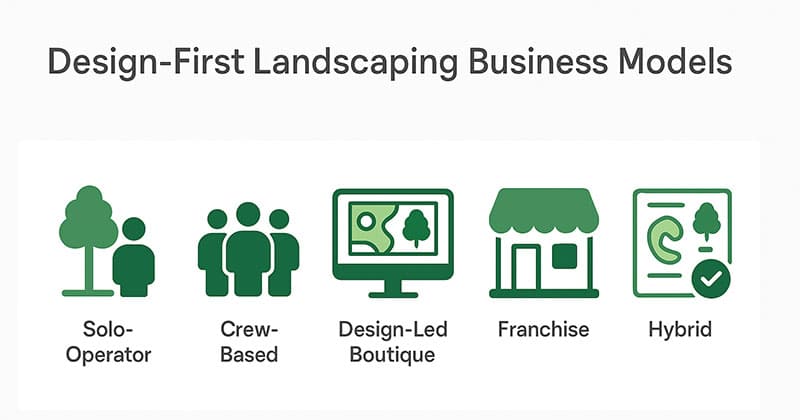
Design-Led Business Models for Landscapers
There’s no one right way to run a creative landscape business. The best model depends on your skills, goals, and how hands-on you want to be with design and installation.
Below are a few proven ways to build a design-led landscaping business.
Solo-Operator Model
Also known as the solopreneur model, this setup is run entirely by one person. It’s common among freelance designers or owner-operators who sell their design time and expertise directly to clients or other landscapers.
You might create landscape plans on a per-project basis or offer ongoing design services to contractors who handle the builds. Some even come from related fields—like architecture, construction, or exterior design—and apply those skills to landscaping.
Going solo is low-risk and easy to start. In fact, more than 70% of U.S. businesses are owned by solo operators.
The Pros:
- Simple and low-cost to start
- Flexible and agile
- Full creative and business control
- Minimal overhead
The Cons:
- Limited capacity and scalability
- Income tied to personal output
- Must rely on your own reputation and marketing
Crew-Based Model
This model centers around a small or mid-size team that handles both design and installation.
The bulk of the revenue usually comes from landscaping work, such as lawn care, hardscaping, or planting. The design side adds value and helps win more projects.
In this setup, the crew often installs their own designs. That means the finished work matches the original concept more closely, keeping creative consistency and boosting client satisfaction.
The Pros:
- Easier to scale and take on more jobs
- Broader range of services
- Team collaboration and shared skills
- Multiple revenue streams
The Cons:
- Higher startup and payroll costs
- More admin and crew management
- Recruiting and training challenges
Design-Led Boutique Model
Design-led boutique landscapers put creativity at the center of their business. Design isn’t just a service—it’s their brand, their differentiator, and often their primary revenue driver.
These firms typically serve upscale residential clients or high-end commercial properties, such as resorts, hotels, and golf courses. They charge premium rates for design and design-build work that emphasizes artistry, precision, and originality.
Most use professional tools such as DynaScape Design, Color, and Sketch3D. These tools allow them to produce detailed 2D plans and immersive 3D renderings that capture every nuance of a concept. These visuals not only impress clients but also make collaboration easier, becoming a shared canvas for refining ideas.
For these companies, design excellence reflects professionalism. And with today’s digital workflows, this model can be highly efficient with quick turnarounds, minimal overhead, and healthy margins.
The Pros:
- High profit margins
- Clear competitive differentiation
- Streamlined, efficient operations
- Strong creative control and flexibility
- High perceived value with clients
The Cons:
- Reliance on a single revenue stream
- Requires strong branding and reputation to sustain premium pricing
- Limited scalability compared to larger, diversified firms
- Smaller target market
Franchise Model
Franchising allows established landscaping brands to expand across multiple locations. It combines proven design systems with consistent branding, helping each branch deliver the same quality and creative style.
Because franchisees share the same reputation and support network, risk is lower than starting from scratch. Many franchises see long-term success and faster growth—a 90% success rate over a five-year period.
That said, franchising works best for firms with a strong brand and established processes. It’s a good fit for business owners ready to grow regionally while keeping creative standards intact.
The Pros:
- Recognizable, trusted brand
- Lower expansion risk
- Shared marketing and support
- Access to larger markets
The Cons:
- High upfront investment
- Potential for conflict with franchisees
- Less flexibility and creative freedom
RELATED ARTICLE: How to Market and Grow Your Landscape Business
Hybrid Model
A hybrid approach combines different business types.
For example, a boutique design firm might add maintenance or hardscaping services. Or a crew-based company might grow its design department. The goal is balance. You want to diversify income without diluting the brand.
Offering multiple services can attract a wider client base and make the business more resilient to seasonal slowdowns. But too much diversification can blur your identity and stretch resources thin.
The Pros:
- Multiple income streams
- Broader customer reach
- Greater stability and flexibility
The Cons:
- More complex operations
- Risk of losing clear brand focus
Comparing Models: Cost, Scalability, and Revenue
Here’s a simple side-by-side look at the main design-led landscaping models to help you compare them against your business vision:
| Model Type | Startup Cost | Avg Monthly Revenue | Ideal for | Scalability |
| Solo-Operator | Low | Low | Freelance creative professionals | Low |
| Crew-Based | Moderate | Moderate | Small-to-mid-size firms offering design and installation | Moderate |
| Design-Led Boutique | High | High | High-end designers focused on luxury projects | Moderate |
| Franchise | High | High | Firms expanding into new regions with consistent branding | High |
| Hybrid | Moderate | Moderate | Owners blending multiple services under one brand | High |
RELATED ARTICLE: How to Start a Landscaping Business in 5 Steps

Modern Monetization Models
Design-led landscaping firms earn money in several ways. Here are the three most common—and profitable—approaches.
Recurring Revenue
Selling to existing customers is easier and far more profitable. Returning clients buy 60–70% of the time, while new prospects only convert 5–20% of the time. They also spend 67% more than new customers.
That’s why many landscaping companies build recurring revenue into their business model. This usually takes the form of a monthly or annual service plan. These plans might include:
- Routine maintenance
- Plant care programs
- Seasonal design updates
- Annual enhancement suggestions
Recurring revenue creates predictable income and steady cash flow. It also builds long-term loyalty because clients receive ongoing value, not just a one-time service.
Service Bundling
Service bundling packages several services into one clear offering. For example, a bundle might include design, installation, and seasonal improvements.
This approach works because:
- Clients enjoy simple, all-in-one pricing
- You can maintain creative control from start to finish
- Billing becomes easier and more consistent
- Profit margins stay steady thanks to set pricing
Transparency is key here. Clients need to understand exactly what’s included so they feel confident in the investment.
White-Label or Affiliate Design Services
This model centers on B2B (business-to-business) partnerships instead of selling directly to homeowners.
Here’s how it works:
- White-labeling: You sell design work to another landscaper, and they brand it as their own.
- Affiliate selling: You keep your branding, and the landscaper earns a referral fee whenever they sell your designs.
This is ideal for freelance designers or firms that want to focus solely on design. You don’t need crews, trucks, or equipment, just your design tools and skills.
While the revenue per project is often lower, the profit margin is high because overhead is minimal.
RELATED ARTICLE: 5 Ways to Boost Revenue Throughout Your Landscape Business Cycle
Choosing the Right Landscaping Business Model
Each business model has its own strengths. The right one depends on your goals, budget, market, and appetite for risk.
Here are key steps to help you make the best choice for your creative landscape business.
RELATED ARTICLE: Landscaping Business Names – 111 Ideas
1. Define Your Creative Focus and Business Goals
Start with a simple question: What type of work do you want to be known for?
Your creative focus shapes the right model. For example:
- If you love design above all else à Solo-operator or boutique model
- If you want to design and build your own concepts à Crew-based or hybrid model
- If you dream of regional expansion à Franchise model
Knowing what you want to offer helps narrow the options.
2. Research the Market
Before choosing a model, confirm there’s actual demand in your area. According to CB Insights, 42% of failed businesses shut down because there was “no market need.”
To ensure you don’t become one of them, research:
- What clients in your region are asking for
- Gaps in design or installation services
- Pricing standards
- Neighborhood demographics
- Seasonal trends
RELATED ARTICLE: 5 Tips for Marketing Your Landscape Business
3. Size Up the Competition
Find out who you’re up against. Study local competitors closely to learn:
- What services do they offer?
- Who do they target?
- How do they price their work?
- What are clients praising—or complaining about?
This helps you see where you can stand out. Competitive insights can also inspire branding, pricing, and service ideas.
4. Consider the Startup Cost
Some models require more money upfront than others. Franchises and boutique studios usually cost more. Solo and hybrid models are more affordable.
It’s important to choose a model you can sustain, not just launch. CB Insights lists running out of money as the second-biggest reason businesses fail.
Pick a model that fits your financial reality.
5. Think About the Earning Potential
Every model has different earning potential. High earnings usually come from higher investment or higher risk.
For example:
- A design-led boutique may serve a small niche, but premium pricing can lead to excellent margins.
- A crew-based model may bring steady volume but requires more staff and equipment.
- A hybrid model may create multiple income streams but requires careful management.
The best choice depends on how fast you want to grow, how much you can invest, and how niche you want to be.
Landscaping Business FAQs
What Is the Best Landscaping Business Model for Beginners?
For a beginner, the solo-operator model is the easiest and lowest cost. It’s ideal for new designers who want to build skills and a portfolio before expanding.
Can You Start a Landscaping Business with No Money?
Yes, you can start a landscaping business with no money. You can start by selling design-only services or subcontracting work to other landscapers. This avoids equipment, crew, and facility costs.
How Much Do Landscaping Businesses Make Per Year?
Small to mid-sized landscaping businesses typically earn $100,000–$200,000 per year. Larger companies often earn much more, depending on the services they offer and market demand.
Is Landscaping a Profitable Business Model?
Yes, landscaping is a highly profitable business venture. On average, landscapers in the US earn around $77,274 per year, and self-employed contractors keep about 5%–20% profit per job.
What Services Are Most Profitable for Landscape Design Companies?
Custom design projects are the most profitable. Clients pay premium rates for unique outdoor plans that reflect their style and property.
Should I Focus on Design, Build, or Both?
It depends on your skills and goals. Offering both design and build services increases your earning potential and strengthens cash flow. But design-only firms can operate with lower costs and stronger creative focus.
Design Your Business as Intentionally as You Design Landscapes
The major advantage of design-first landscaping businesses is that creativity leads the way. Creativity becomes the engine that drives profit, reputation, and long-term growth.
Whether you choose to work solo, build a crew, specialize as a boutique studio, expand through franchising, or mix models with a hybrid approach, the key is finding a structure that supports both your artistic vision and your business goals.
Take time to understand your market, define what you want to be known for, and choose a model that fits your budget and lifestyle.
When you lead with design—and support it with the right processes and tools—you can build a landscaping business that stands out, scales smartly, and delivers work you’re proud of.